Study: Everyone is cheating on Wordle, according to Google search data.

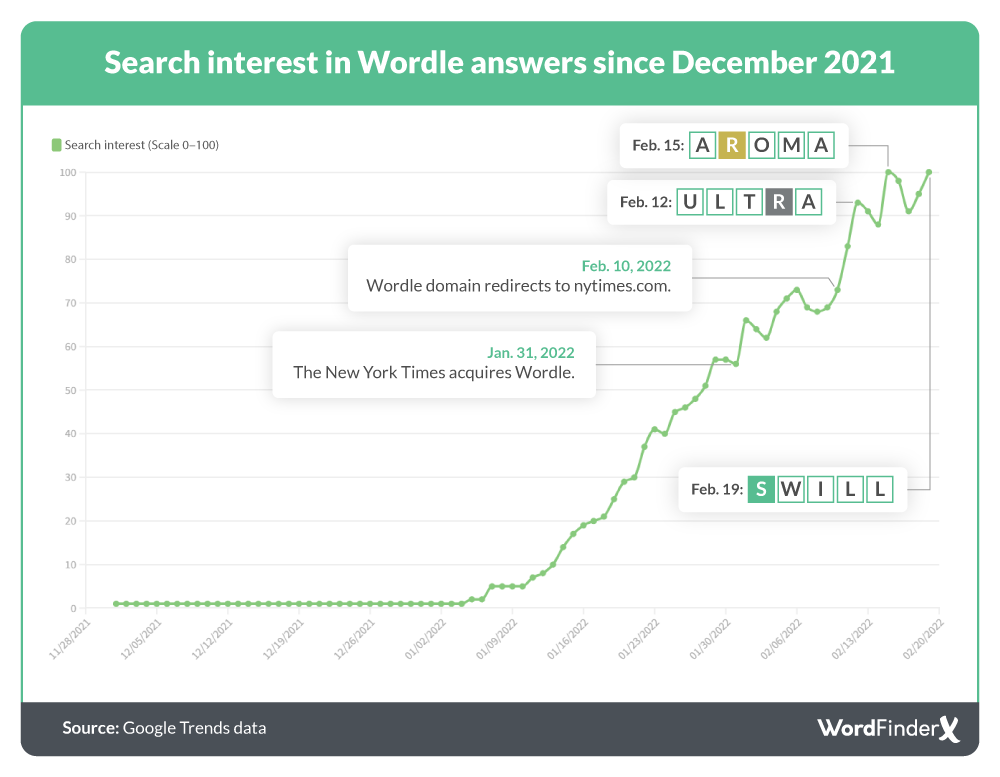
Since The New York Times bought Wordle at the end of January of 2022, cheating has been at an all-time high among Wordle users. In December 2021, search interest for the question “today’s wordle” on Google was so low it registered a “0” for search popularity, but by February 15, searches for Wordle answers reached peak popularity (registering 100 on Google’s scale from 0–100). Here are some of our findings from a Google Trends exploration of Wordle.
Key findings
- SWILL and AROMA were the words players cheated for most. Both registered 100s on Google’s search popularity scale (0–100). In comparison, on January 4, SIEGE registered a 1 on the scale.
- Wordle cheaters were usually looking up the answers between 7 and 8 a.m.
- The biggest cheaters on Wordle were from New Hampshire.
Cheating has only gotten worse on Wordle
Biggest cheaters and the Wordle answers they cheated for:
- New Hampshire: Swill
- Rhode Island (tied): Caulk
- Vermont (tied): Tacit
- Washington, D.C.: Tacit
- Massachusetts: Dodge
- Maine: Dodge and Tacit
Methodology and Limitations
We analyzed Google Trends data from December 2021 to February 2022 to see how often Wordle players cheated by looking up answers online.
As Google's Trends Help explains, Trends values are not search counts: each data point is divided by the total searches in that place and time range, then scaled from 0 to 100. A state ranks high when Wordle-answer searches make up a large share of its searches, not because it has the most searches.